Can We Set Up a Complete Network for Your Business?
Absolutely. A reliable business network is more than just connecting a few computers to the internet. Your network needs to support your employees, printers, CCTV cameras, servers, Wi-Fi devices, and other systems without constantly causing problems.
At ProNet IT Solutions, we first understand how your business works and what you actually need. Then we plan the network around your workplace instead of simply installing whatever equipment is available.
What Does a Complete Business Network Include?
Network Planning We look at your office layout, number of users, devices, internet connection, and future requirements before deciding how the network should be designed.
Router & Switch Configuration Properly configured networking equipment helps your devices communicate efficiently and keeps your business connection organized.
Network Security Your business network should not be left open to unnecessary risks. We can configure appropriate security settings and access controls to help protect your systems and data.
Printers, CCTV & Shared Devices We can connect network printers, CCTV systems, servers, and other devices so they can work smoothly within your business environment.
Server & Active Directory Integration For businesses that need centralized user and computer management, we can configure servers and Active Directory to make access and administration easier.
What If Your Business Is Growing?
Your network should be able to grow with you. Adding employees, computers, CCTV cameras, printers, or other devices shouldn’t mean rebuilding everything from scratch.
That’s why we consider future expansion when planning your network.
A Network That Simply Works
You shouldn’t have to spend your day wondering why the Wi-Fi stopped working or why one computer can’t access the printer. A properly planned network gives your team a more stable environment and makes everyday IT management much easier.
ProNet IT Solutions can help you plan, install, configure, and maintain a business network built around your actual requirements.
Need a network for your business? Let’s talk about what you need.
How to Choose the Right IT Support Company for Your Business in 2026
Technology plays a central role in almost every modern business. Employees depend on computers, internet connections, business applications, cloud platforms, networks, printers, communication systems, and digital data to complete their daily work.
When everything works properly, technology can help a business operate efficiently. But when a network suddenly stops working, a computer becomes unusably slow, important files cannot be accessed, or a security problem affects the business, even a relatively small IT issue can quickly become expensive.
For this reason, choosing the right IT support company is an important decision for businesses of every size.
The right IT provider should do more than fix computers when something goes wrong. Ideally, it should help your business maintain reliable technology, reduce downtime, improve security, and plan for future technology requirements.
In this guide, we explain the most important factors to consider when choosing an IT support company in 2026.
What Is an IT Support Company?
An IT support company provides technical assistance and technology-related services to businesses and organizations.
Depending on the provider and the business’s requirements, IT support may include:
Computer and laptop troubleshooting
Network installation and maintenance
Server support
Internet and Wi-Fi troubleshooting
Software installation and configuration
Cybersecurity assistance
Data backup solutions
Cloud technology support
Hardware support
IT consulting
System monitoring and maintenance
Disaster recovery planning
Some companies provide support only when a problem occurs, while others offer ongoing managed IT services designed to identify and prevent problems before they cause significant disruption.
Before choosing a provider, it is important to understand what your business actually needs.
Why Does Your Business Need Professional IT Support?
Some businesses try to manage all technology internally. This can work when the business is very small and its IT requirements are simple.
However, technology becomes increasingly difficult to manage as a company grows.
More employees may mean more computers, phones, network devices, accounts, applications, and security requirements. A business may also need better backups, improved Wi-Fi coverage, stronger security controls, and reliable systems for remote employees.
Professional IT support can help businesses manage these requirements more efficiently.
Reduce Business Downtime
When an important technology system stops working, employees may be unable to perform their jobs.
For example, a network outage can prevent employees from accessing shared resources, cloud applications, printers, or other business systems.
A responsive IT support provider can help diagnose technical problems and restore services as quickly as possible.
Improve Technology Security
Cybersecurity is another important reason to work with an experienced IT provider.
Businesses can face risks from phishing emails, malware, compromised passwords, unauthorized access, outdated software, and other security weaknesses.
An IT provider can help businesses establish stronger security practices and identify areas that require improvement.
Make Technology More Reliable
IT support is not only about fixing problems.
Regular maintenance, monitoring, updates, backups, and proper configuration can help create a more stable technology environment.
Support Business Growth
Technology requirements often change as a business grows.
A company opening a new office may need a new network. A growing team may require additional devices and user accounts. A business adopting cloud applications may need help configuring and securing those systems.
A good IT partner should be able to adapt as these requirements change.
8 Factors to Consider When Choosing an IT Support Company
There are many IT providers available, but they are not all the same. Before signing an agreement, compare providers using several factors rather than choosing based on price alone.
1. Experience and Technical Expertise
Start by looking at the provider’s experience.
Ask whether the company has experience supporting businesses similar to yours.
Different organizations can have very different technology requirements. A small office, retail business, professional services company, school, or larger organization may require different types of IT infrastructure.
You should also consider whether the provider has experience with the technologies your business uses.
Ask questions such as:
What types of businesses do you support?
What technologies do you work with?
Can you support our existing infrastructure?
Do you provide both remote and on-site assistance?
How do you handle complex technical problems?
A provider should be able to clearly explain how its experience can benefit your organization.
2. Range of IT Support Services
Consider whether the provider can support your current and future requirements.
For example, you may initially need help with computers and networking. Later, you may require cybersecurity, backup, cloud support, or disaster recovery services.
Working with a provider capable of handling multiple IT requirements can make technology management simpler.
However, do not choose a provider simply because it lists a large number of services.
Look at the quality, experience, and relevance of those services to your business.
3. Response Time and Availability
When technology stops working, response time matters.
Before choosing an IT support company, find out how support requests are handled.
Important questions include:
How can customers contact support?
What is the expected response time?
Is emergency support available?
Is remote support available?
Is on-site assistance available when necessary?
Are support requests tracked through a ticketing system?
Make sure the provider’s support commitments are clearly explained before you sign a contract.
A company that promises fast support but does not clearly define its service process may not provide the level of reliability your business requires.
4. Proactive vs. Reactive IT Support
One of the most important differences between IT providers is whether they take a proactive or reactive approach.
Reactive IT Support
Reactive support means the business contacts the IT provider after a problem occurs.
For example:
The internet stopped working, so the company calls its IT provider.
This model may be suitable for businesses with limited technology requirements.
Proactive IT Support
Proactive IT support focuses on preventing problems before they become major disruptions.
Depending on the service, this may involve:
System monitoring
Software updates
Security checks
Backup monitoring
Device maintenance
Network monitoring
Identifying potential failures
For businesses that depend heavily on technology, proactive maintenance can be an important part of a long-term IT strategy.
5. Cybersecurity Approach
Security should be one of the first topics you discuss with an IT provider.
Ask how the company approaches cybersecurity and what measures it recommends for businesses.
Potential areas include:
Endpoint protection
Network security
Password management
Access controls
Software updates
Employee security awareness
Backup protection
Monitoring
Security incident response
You should also ask how the provider handles access to your systems and business information.
An IT company may have significant access to your technology environment, so trust, security practices, and clear processes are extremely important.
6. Backup and Disaster Recovery
Backups are essential because hardware can fail, files can be accidentally deleted, and businesses can experience security incidents or other unexpected events.
Ask potential IT providers:
How should our business data be backed up?
How frequently should backups occur?
How are backups protected?
How is backup recovery tested?
What happens if a critical system becomes unavailable?
A backup that cannot be successfully restored is not a reliable recovery strategy.
For this reason, businesses should consider both backup procedures and disaster recovery planning.
7. Transparent Pricing
Cost is obviously important, but the cheapest IT provider is not necessarily the best option.
IT companies may use different pricing models.
Some provide monthly managed IT packages, while others charge hourly or per support request.
Before signing an agreement, ask about:
Monthly fees
Included services
Additional support charges
Emergency support costs
On-site support fees
Hardware and software costs
Licensing
Contract duration
Cancellation terms
A clear pricing structure makes it easier to calculate the actual cost of IT support.
8. Communication and Customer Service
Technical knowledge is important, but communication is equally valuable.
A good IT support company should be able to explain technical issues in language that business owners and employees can understand.
For example, instead of simply saying that a network has a configuration problem, the provider should explain:
What happened
Why it happened
What impact it has
What solution is recommended
How long the solution may take
Whether the problem could happen again
Good communication helps businesses make better technology decisions.
Managed IT Services vs. On-Demand IT Support
One of the decisions businesses may face is whether to use managed IT services or on-demand support.
On-Demand IT Support
With on-demand support, you contact an IT provider when you experience a technical problem.
This approach may be suitable for businesses with simple technology requirements or organizations that only occasionally need external technical assistance.
The potential disadvantage is that problems may only be addressed after they have already affected employees.
Managed IT Services
Managed IT services generally involve ongoing technology management.
Depending on the provider and package, services may include monitoring, maintenance, updates, security management, backups, technical support, and IT planning.
This approach can be useful for businesses that depend heavily on their technology infrastructure and want more predictable ongoing support.
The best choice depends on your business size, technology requirements, budget, and risk tolerance.
Questions to Ask Before Hiring an IT Support Company
Before making your final decision, prepare a list of questions.
Here are some useful ones:
How long have you been providing IT support?
Do you have experience supporting businesses similar to ours?
What IT services do you provide?
What is your average response process for support requests?
Do you provide emergency support?
Do you offer remote and on-site support?
How do you approach cybersecurity?
How do you manage business backups?
Do you provide proactive monitoring and maintenance?
What pricing model do you use?
What services are included in the monthly fee?
Are there additional charges?
How do you handle technology problems outside normal business hours?
Can your services scale as our business grows?
What happens if we decide to change providers?
The answers can help you compare providers objectively.
Red Flags to Watch For
While comparing IT companies, pay attention to potential warning signs.
Unclear Pricing
If a provider cannot explain what you are paying for, you may encounter unexpected costs later.
No Clear Support Process
A professional provider should have a defined process for receiving, prioritizing, and resolving support requests.
Poor Communication
If technical information is consistently difficult to understand or support requests are ignored, this may become a problem later.
No Focus on Security
An IT provider should understand that cybersecurity is an important part of modern business technology.
Only Fixing Problems After They Happen
For businesses that rely heavily on technology, a completely reactive approach may leave important risks unidentified.
Should You Choose a Local IT Support Company?
For many businesses, having access to a local IT provider can be useful, particularly when on-site assistance is required.
A local provider may be able to visit your office when a problem cannot be resolved remotely.
However, location should not be the only consideration.
You should also evaluate technical expertise, response time, security practices, service quality, pricing, and reputation.
The best IT support company is one that fits your actual business requirements.
How to Compare IT Support Companies
A simple comparison process can make your decision easier.
Create a shortlist of several providers and compare them across:
Factor
What to Look For
Experience
Relevant business and technical experience
Services
Services that match your requirements
Response
Clear support and response process
Security
Practical cybersecurity approach
Backup
Reliable backup and recovery strategy
Pricing
Transparent and understandable costs
Scalability
Ability to support future growth
Communication
Clear and responsive customer service
Do not automatically select the company with the lowest price.
Instead, consider the overall value, reliability, expertise, and level of support you are receiving.
Final Thoughts
Choosing the right IT support company can have a significant impact on your business’s technology reliability, security, and productivity.
The right provider should understand your business requirements and offer appropriate technical support rather than simply fixing problems when they occur.
Before choosing an IT partner, evaluate its experience, range of services, response process, cybersecurity approach, backup strategy, pricing, communication, and ability to support your future growth.
Most importantly, choose an IT support company that you can trust with your business technology.
A strong IT support relationship can help your business maintain more reliable systems today while preparing for the technology requirements of tomorrow.
Frequently Asked Questions
1. What does an IT support company do?
An IT support company helps businesses manage and troubleshoot technology systems. Services can include computer support, networking, cybersecurity, backups, cloud services, system maintenance, and IT consulting.
2. How much does IT support cost for a small business?
The cost varies depending on the number of users and devices, services required, support model, infrastructure, and provider. Businesses should compare the total service package rather than looking only at the advertised monthly price.
3. What is managed IT support?
Managed IT support is an ongoing approach to technology management. Depending on the provider, it can include monitoring, maintenance, technical support, security, backups, and other IT services.
4. Is managed IT support better than on-demand support?
It depends on the business. On-demand support can be suitable for companies with limited IT needs, while managed support may be more appropriate for businesses that depend heavily on technology and want ongoing maintenance and monitoring.
5. Should a small business hire an IT support company?
A small business can benefit from professional IT support when its technology becomes too complex to manage internally or when downtime, cybersecurity, backups, and reliability become important concerns.
6. What should I ask an IT support company before hiring them?
Ask about their experience, services, response times, cybersecurity practices, backup strategy, pricing, support availability, contract terms, and experience with businesses similar to yours.
7. Why is cybersecurity important for businesses?
Businesses store and process valuable information and rely on connected technology. Weak security can increase the risk of unauthorized access, malware, phishing, data loss, and operational disruption.
8. What is proactive IT support?
Proactive IT support focuses on identifying and addressing potential technology problems before they cause significant disruption. It may involve monitoring, maintenance, updates, backups, and security checks.
9. What is the difference between IT support and IT consulting?
IT support generally focuses on maintaining and troubleshooting existing technology. IT consulting is often more focused on planning, strategy, technology selection, infrastructure improvements, and long-term business goals.
10. How do I choose the best IT support company?
Compare providers based on relevant experience, services, response times, security practices, backup capabilities, pricing transparency, communication, and ability to support your business as it grows.
Ready to Improve Your Business IT?
Choosing an IT support partner is an important decision. The right provider can help your business maintain reliable technology, address technical problems efficiently, and plan for future IT requirements.
If your business is looking for professional technology support, Pro Net IT Solutions can be considered as part of your evaluation process.
Get in touch with the Pro Net IT Solutions team to discuss your business technology requirements and determine which IT solutions may be appropriate for your organization.
CCTV Installation: What to Know Before You Install
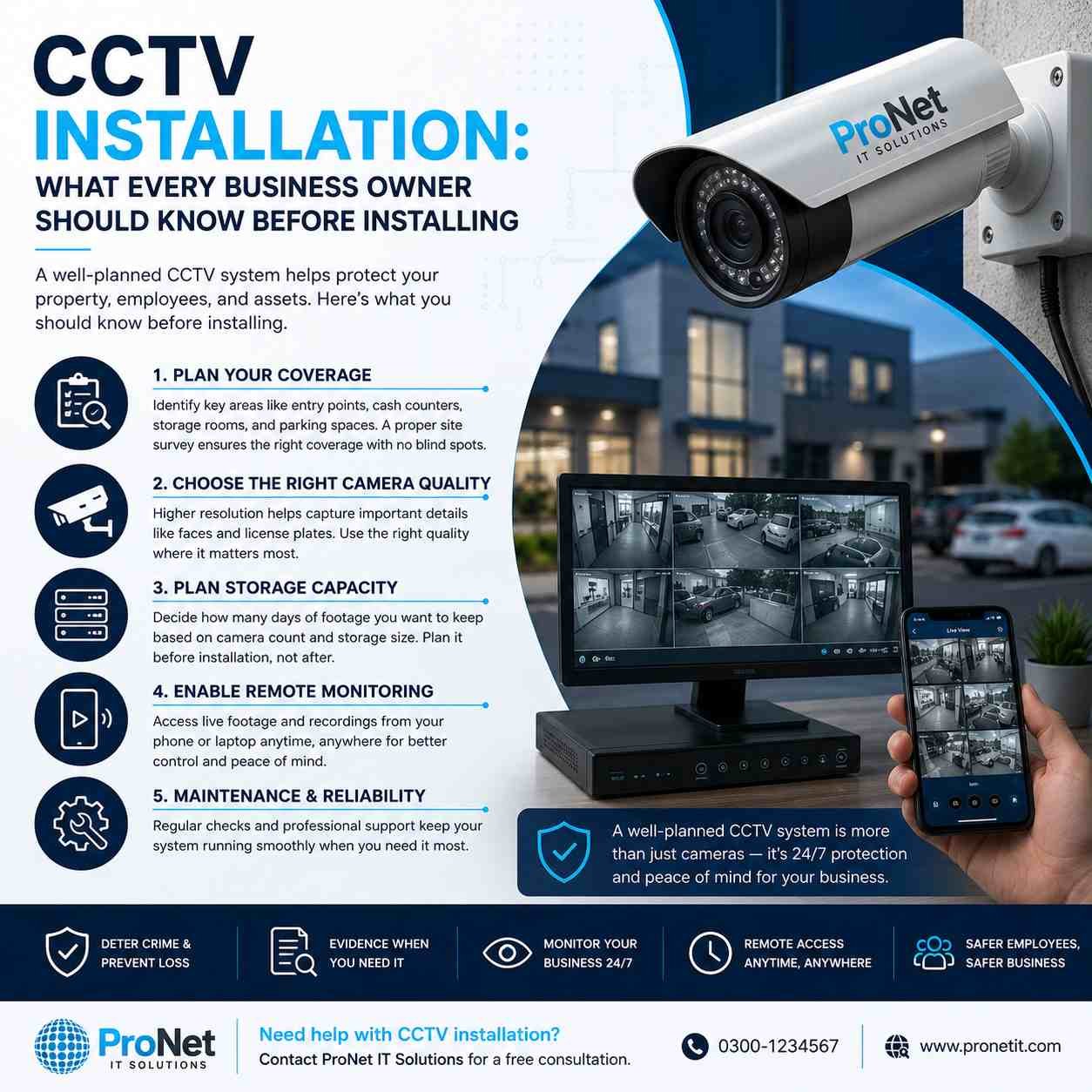
A CCTV system is only useful when it is planned around the actual needs of your business. Simply installing cameras without considering their position, image quality, storage, and access can leave important areas unprotected or result in footage that isn’t useful when you need it.
1. Plan Your Camera Coverage Start by identifying the areas that matter most, such as entrances, reception desks, cash handling points, storage rooms, corridors, and parking areas. A proper site assessment helps determine the right camera positions and reduces unwanted blind spots.
2. Choose the Right Camera Quality Not every location needs the same level of detail. Areas where you may need to recognize faces, vehicles, or other important details should have cameras with suitable resolution and features.
3. Decide How Long to Keep Footage Your storage requirements depend on the number of cameras, recording quality, and how many days of footage you want to retain. Planning this before installation helps avoid running out of storage later.
4. Consider Remote Monitoring Modern CCTV systems can allow authorized users to view live cameras and recordings from a phone, tablet, or computer. This can be especially useful when you’re away from the office or managing multiple locations.
5. Think About Maintenance and Reliability A CCTV system needs more than installation. Reliable equipment, proper configuration, regular checks, and professional support can help keep your cameras and recordings working when they matter most.
Security That Gives You Confidence
A well-designed CCTV system does more than record what’s happening. It helps you monitor your workplace, protect important areas, and have greater peace of mind knowing your business is being watched around the clock.
ProNet IT Solutions can help you plan, install, configure, and maintain a CCTV solution based on your business’s actual requirements.